BR British Rail Crimson & Cream
Crimson and Cream Crimson Cream Blood & Custard Blood Custard Blood and
Custard BR British Rail Crimson & Cream Crimson and Cream Crimson Cream
Blood & Custard Blood Custard Blood and Custard BR British Rail Crimson
& Cream Crimson and Cream Crimson Cream Blood & Custard Blood Custard
Blood and Custard
Portslade
Ronuk Ltd
Sussex
|
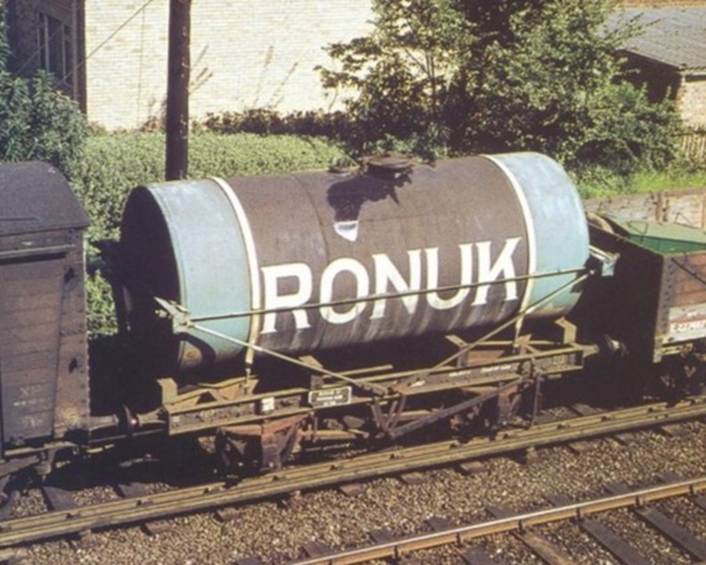
Much gratitude is given to the
photographer of this acid-wash stained Ronuk Class
‘B’ tank wagon in 1960. |
Producing
a range polishes, the name Ronuk being an Anglicised
form of ronak (Kurdish ‘clear’) /ronaq
(Urdu ‘lustre’) /raunaq (Persian). Ronuk Ltd moved from Brighton to its new Portslade factory
in 1902 and was rail-served from c.1920.
Ronuk Ltd appears to have had between three
and six railway tankers in the number range 34 to 39 [R. Tourette Petroleum
Rail Tank Wagons of Britain] and it is possible these may not all have been
in service at the same time. However, there did appear to be at least three at
the cessation of their rail operations.
Petrochemical regulations including spirits and oils were
considered class ‘A’ if the flash point of the material was below 23°C and
class ‘B’ if it was 23°C or above (but below 60°C).
Ronuk Ltd used White Spirit for its paste
waxes and liquid polishes - typically standard White Spirit has a flashpoint of
between 38°C and 43°C (which could be conveyed in a Class ‘B’ tanker).
Ronuk Ltd also used Petroleum Distillate (again
for its paste waxes and liquid polishes) - Petroleum Distillate’s flashpoint
could range from between -40°C (which would need to be conveyed in a Class ‘A’
tanker) to over 200°C (which did not).
The
White Spirit and Petroleum Distillate tank wagons operated between Esso
(Fawley) and Portslade with evidence suggesting only one 3,500 gallon tanker wagon
at a time was present at any given, although the frequency of deliveries is
currently unknown.
Finally,
Ronuk Ltd used Xylole (these
days more commonly known as Xylene) as a solvent for the tar-based wood dyes - typically
Xylene has as flashpoint of between 24°C to 30°C (which could be conveyed in
a Class ‘B’ tanker). It is currently not known from where Ronuk Ltd sourced this.
Through the process of catalytic reforming, Xylene is produced
from Petroleum Naphtha (the main feedstock used in refineries), Crude Oil (contains
natural Xylene concentrations of about 0.5% to 1%) and Crude Benzol (recovered
as a byproduct during the manufacture of coke fuel from coal carbonization). For
the production of Xylene, preheated naphtha is passed over a platinum-aluminum or similar catalyst at high temperatures to
convert aliphatic hydrocarbons into aromatic hydrocarbons (forming a mixture
known as reformate). Through aromatic extraction, solvents like sulfolane are
used to extract the BTX fraction (Benzene, Toluene, and the three isomers of Xylene
- o-xylene, m-xylene, and p-xylene) from the reformate.
In
the nineteen fifties Teeside was the undisputed hub
of post-war British xylene production, split between traditional coal-tar
distillation and cutting-edge petroleum cracking Of the key suppliers Port
Clarence Works (Middlesbrough) was operated by Dorman Long (Chemicals) Limited
with (from 1946) Wilton & Billingham Complexes (Redcar & Cleveland) was
operated by Imperial Chemical Industries (ICI) although (from 1951) Grangemouth
(British Hydrocarbon Chemicals) was another potential supplier. However, Fawley
(Esso Petroleum) was not a supplier of Xylene.
The
finished products were supplied in metal tins; originally manufactured
in-house, these tins being procured from the nearby Metal Box Company Ltd
factory at Portslade and with whom Ronuk shared
railway siding space. Ronuk’s finish products were
dispatched nationally in railway box vans (including crated tins and 45 gallon
drums).
On
30th April 1960 it was reported in The Times that Ronuk Ltd had accepted an offer by Newton, Chambers &
Co. Ltd to acquire the business. With the acquisition, Izal Overseas Ltd gained a presence in Ronuk
Ltd’s Portslade offices with the Ronuk-company
brand-names such as Colton (from 1927) & Ronseal (from 1956) being absorbed
into Izal during 1963. By the end of 1964 the
Portslade factory had been closed with production having moved to the Izal factory in Chapeltown, Sheffield.
There
appears to have been at least two liveries of Ronuk
tanker wagon (plus variations in lettering thereon); the first being Class ‘A’ outshopped
in plain blue with ‘RONUK’ on the tank [as modelled by Dapol]. This was subsequently amended in a
different typeface which included ‘PORTSLADE, ENGLAND’ underneath ‘RONUK’ with
this arrangement surviving to at least March 1961 [Ian D. Nolan photograph
of no.38 at Hove on 11th March 1961].
Class ‘A’ tank wagon no.38 was built by Hurst Nelson & Co.
Ltd (Motherwell) in July 1938; being registered by the SR as number 747.
Many
Class ‘A’ tank wagons were commissioned for World War Two because of the huge
need for fuel; particularly the wartime airfields. However, following the end
of hostilities, many of these wagons were sold as surplus to requirements; some
being modified to convey Class ‘B’ products. The matt black band livery may
have been applied to a subsequent wagon acquisition(s) in order to hide
spillages of Class ‘B’ content.
The
second Ronuk tank wagon livery saw the addition of a
wide matt black band (with white tank straps) around the middle of the blue
tank barrel [as modelled by Bachman /Graham Farish] and this
livery was present in 1960. The wagon number is not know and is unlikely to be Class
‘A’ no.38 again as the colour photograph appears to be 1960.
As
an aside, in 1958 Ransomes and Rapier were acquired by Newton, Chambers and Co.
|
|
|
|
COPYRIGHT BLOODANDCUSTARD PHOTOGRAPHIC COPYRIGHT AS INDICATED |
|