BR British Rail Crimson & Cream
Crimson and Cream Crimson Cream Blood & Custard Blood Custard Blood and
Custard BR British Rail Crimson & Cream Crimson and Cream Crimson Cream
Blood & Custard Blood Custard Blood and Custard BR British Rail Crimson
& Cream Crimson and Cream Crimson Cream Blood & Custard Blood Custard
Blood and Custard
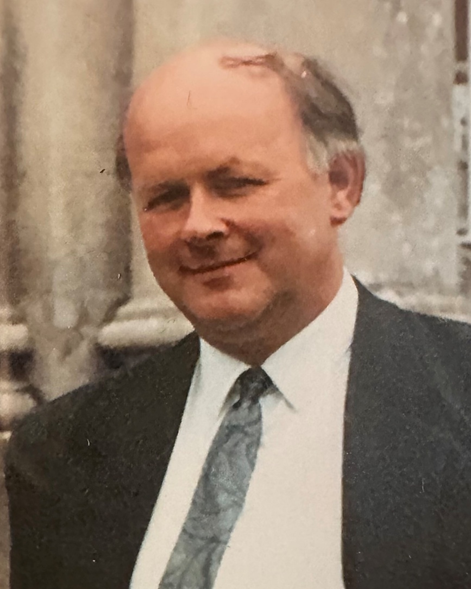
The Railway Career of
Richard F.
Cawley
8th July 1946 – 3rd March 2008
Around 9am on Sunday, 2nd March 2008 I
tried telephoning my good friend Richard regarding the potential purchase of
some computers we been discussing the night before. However, despite expecting
my call he did not answer. Nor did he answer throughout the day or even the
next.
Around 5pm on Monday, 3rd March 2008
another of Richard’s close friends (Paul Towler) answered his phone to
say Richard was dead. He was found in his lounge (which overlooked the Bluebell
Railway), sitting down on the floor in his usual comfortable ‘ready to
answer’ the telephone position – possibly my 9am call Sunday that
morning.
His funeral was well attended (mainly colleagues
from British Rail’s S&T department) being ushered in to the loud
sounds of wagons being shunted and closing to the tune of ‘The Runaway
Train’ [Vernon Dalhart 1931].
In my giving Richard’s eulogy, some looked
confused not realising that two railwayman who’d in the past occasionally
appeared to share professional differences were actually close friends, fellow
genealogists and model railway enthusiasts (Richard had an extensive 4mm layout
incorporating working ‘25kV’ overhead).
Richard’s
home was always well stocked with preserve home-made by my partner (Marie) from
the Plums picked each year from Richard’s orchard!
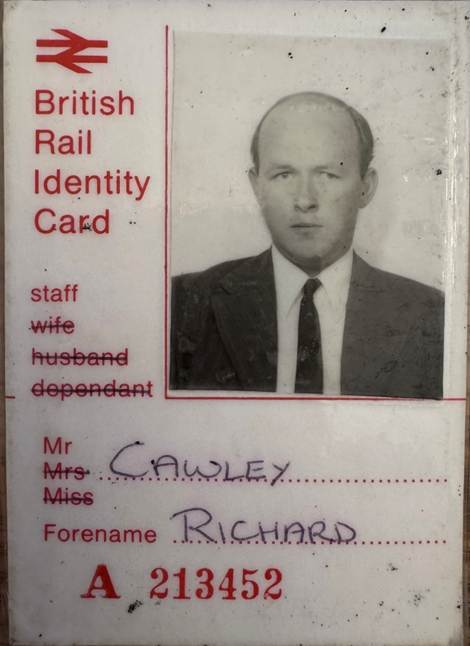
Several years previously (around the time of becoming
one of Her Majesty’s Inspector’s of Railways) Richard had given me
a copy of his railway career history which is repeated below.
Colin Watts
|
The Career of R.F.Cawley Born in 1946 I attended the Ashford County Grammar
School (Middlesex) from 1957 to 1964. My enginerring career started with a
five year student apprecticeship with Electronic Instruments Ltd. of Richmond
(which eventually became part of the ABB group) latterly with a bias towards
industrial instrumentation and control, which when working in power stations
invariably meant you needed an understanding of the power side. Initially I had day release to obtain an ONC in
Enginerring at Twickenham College of Technology. Following a change in
company training policy I was then transferred to a block release HND /Dip.
Tech course, during the final exams for which I was taken ill and was unable
to sit all the papers due to the risk of permanent damage to my eyesight. In
accordance with the rules at the time I would have to repeat the final year
before I could retake the exam, so I had nothing to show on paper for the
final three years of college work. I did not repeat this final year as my
apprecticeship had finished and I could not afford a further six months at
college at my own expense. As Electronic Instruments Ltd. were unable to offer me
a suitable permanent appointment at the end of my apprecinticeship I
therefore joined Bristish Rail in 1970 at Croydon as a Technical Officer in
the Southern Region Design Office. I was promoted to Senior Technical Officer in 1971 and
in 1979 to Section Leader in charge of 10 staff, which post was responsible
for checking the accuracy of drawings and other work produced on the section.
Following various reorganisations this post increasingly was required to
undertake the functional test on site of signalling alterations that had been
designed by the section. In late 1986 with further reorganisation pending
(which on the railway puts an embargo on posts being permanently filled) I
was asked to cover the Deputy Signalling Design Engineer, Southern Region
post. Besides running the Design Office of 136 staff on a day to day basis
this post was responsible for the ‘common services’ and in the
absence of the Design Engineer was required to make recommendations of
decisions in situations where it was not possible to comply with Signalling
Principles or Instructions. This was an era of great change in signalling with
computer based SSI interlockings and IECC workstations for signalmen
beginning to take over from hard wired relay interlockings with push button
panels on new schemes. As part of the ‘common services’ I
therefore had to introduce workstations to enable data preparation for SSI
and IECC schemes while at the same time getting the CAD system working
efficiently, as intially this project was over ambitious and created more
work than it saved. This new equipment also created a major training
requirement for staff who were already over stretched. Up until this time records had been kept as full sized
negatives apart from a rather disastrous experiement with microfilming which
had resulted in the loss of some records. The need to store masters of safety
critical records in both paper and magnetic form reliably at a time when bomb
threats were being made against the building involved a fundamental review of
past practices and procedures. At the same time the sheer volume (and weight)
of the records that some fault teams needed on site possibly out in the rain
at night resulted in me investigating other industries practices and what new
technology was available in this area as part of my ‘common
service’ remit. The April 1988 reorganisation saw the five Signalling
Design Offices removed from the Regions and placed under central control by
the British Railways Board (BRB) and I was appointed Resources & Services
Engineer at Croydon, an MS3 post (MS3 being the middle of the five Management
Grades in the BR structure). This post continued in the ‘common
services’ role but also gave my section long term resource planning and
contract letting and management responsibilities. Until this time the Design Offices had always been
funded as an ‘overhead’ but with privatisation on the horizon the
BRB decided that the Design Offices should function as Self Accounting Units
(SAUs), effectively internal companies with the costs being allocated to the
actual jobs being designed in order to establish true costs. I was nominated
for thier national working party which set this up and wrote the trading
rules for SAU’s which resulted in me having to learn a lot about
financial management and accountancy regulations in a very short time scale. After the Purley accident in March 1989 I was seconded
back to the Southern Region to lead a team investigating why certain signals
were passed at danger (SPAD) on several occassions as happened at Purley
while apparently similar signals did not have a problem. When we looked at
thirteen signals on the Southern Region which had been SPAD three or more
times we found contributory factors in every case and I was called to the
Public Enquiry as an expert witness on these investigations. After the intial investigation I returned to my
substantive post but for the next year was pregressively being
‘borrowed’ by the
Region for more and more of the sime as SPADs emerged as a developing problem
until at Easter 1990 the situation was regularised when I was promoted to MS4
grade to act as deputy to the Region (and subsequently Network South East)
Signal Performance Engineer with a specific remit to oversee incident and
accident investigations, equipment and procedural weaknesses and the
resultant remedial action. Over the next five years I became the Signal Engineers
national expert on SPADs, chaired on committee drafting Railway Group
Standards, participated in other committes and also acted as Technical
Director for the production of railway training courses on Signal Sightings
and SPAD investigation. From the issues that came out of the SPAD
investigations in conjunction with the operators and rolling stock engineers
we had to completely revise how faults with Automatic Warning System (AWS)
were reported, investigated and managed and we also set up a
‘Driver’s Contact Line’ where drivers could talk to a
senior engineer if the were oncerned about faults or incidents they
encountered. This was probably the most interesting part of my career
as I had one group of staff in the office doing analysis on failures looking
for emerging problems while I and a second group of staff spent much of our
time out on the ‘real’ railway. Besides the purely engineering
problems we uncovered we often had to stray into areas of psychology, human
reactions, why the human eyedoes not always see what you expect it to see,
etc. not to mention loopholes in rules and instructions. In researching some of these issues it was not unusual
to work with experts from outside the railway industry on such matters such
as human behavious. My sponsor R.M. Bell was my line manager for part of this
period although we are both involved with similar issues up to the present
day. While much had been achieved three was still a lot
more that needed finishing but Railtrack’s take-over in 1994 saw most
of this work scrapped. I personally was told that Railtrack had no need for
me or my staff as “they were going to be a totally safe company who
did not have accidents !!” and therefore did not need an incident
investigator such as myself. Following the Cowden accident where again I was called
as an expert witness at the Public Enquiry it was obvious that people were
more interested in passing the blame than investigating what happened to
ensure that there was no repetition so I therefore took the severance package
and ‘retired’ at the age of 48 at the end of March 1995. Before I even left BR I was being approached to
undertake specific investigations so I therefore set up as a self employed
consultant on a part time basis. While I still perform some railway
consultancy work I am very selective about the work I take on and actually
turn down the vast majority of the work that I am offered as I cannot be
bothered to work for organisations who do not listen to things they do not
want to hear. With the spiralling cost of insurance much of my current
railway involvement is with private (preserved) railways usually for a
nominal fee although I have recently been suggested as a possible independent
expert witness for a certain police inquiry. R.F. Cawley Notes in
respect of Richard’s Career History 1.
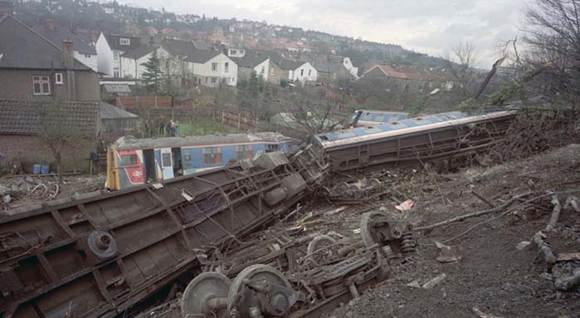
Immediately to the north of Purley station at 13:39hrs on
Saturday 4th March 1989, the
12.17hrs Littlehampton to Victoria express train past a signal a danger
crashing into the rear of the 12.50hrs Horsham to Victoria bound train
claiming the lives of five people and leaving eighty-eight injured. Several
coaches came to rest in gardens at the foot of the railway embankment.
(With thanks to the
London Fire Commisioner). 2.
Approximately 300m south of Cowden station, at
approximately 08.27hrs on Saturday 15th October 1994, the 08.00hrs
Uckfield to Oxted passenger train passed signal OD58 at danger and collided
head-on with the 08.04hrs Oxted to Uckfield passenger train. Both trains were
operated by the Network South Central Train Operating Unit of British Railways
Board. As a direct consequence there were five fatalities and twelve
injuries. Richard was called as an Expert Witness in respect of Up signal
OD58 in the passing loop Ashurst. 3.
The Police inquiry to which Richard alluded, was into the
fatal head-on collision at Ladbrook Grove at 08.09hrs on 5th
October 1999 for which Richard had prepared a report for British Rail
recommending Signal SN109 not be commissioned; this signal was later critised
in the subsequent Public Enquiry for its poor sighting. SN109 had been passed
at danger by the 08.06hrs Paddingto to Bedwyn train (operated by Thames
Trains) and collided head on with the 06.03hrs Cheltenham to Paddinton train
(operated by First Great Western with thirty-one fatalities and two-hundred
and fifty-eight injuries. |
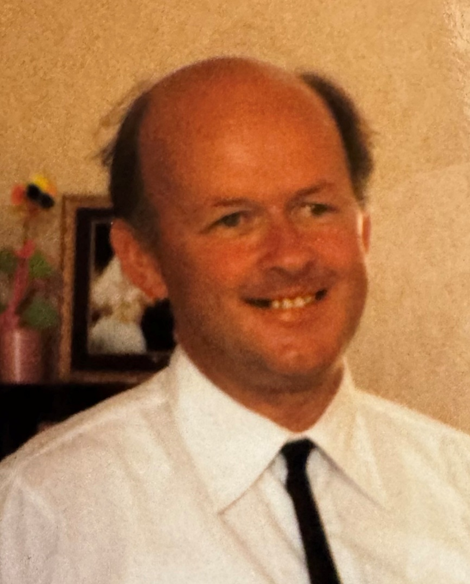
Richard Frank Cawley
8th
July 1946 – 3rd March 2008
Son of Molly & John
Cawley
|
Richard was survived by his Tortotise ‘George’
(whom he had since a child) and now resides with other Torotoises near
Liphook in Hampshire. |
|
COPYRIGHT BLOODANDCUSTARD PHOTOGRAPHIC
COPYRIGHT PAUL TOWLER 12th January 2025 |