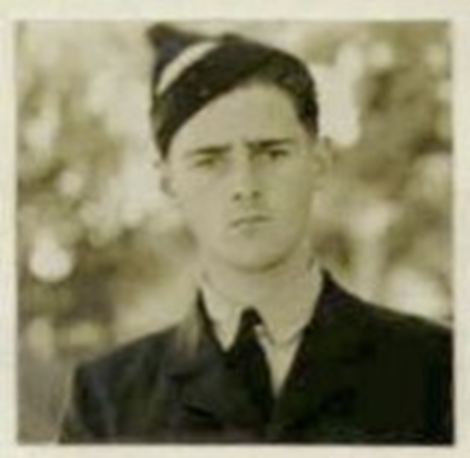
William ‘Bill’ Gadd
(RAAF)
Southern Railway
Collision between
a Spitfire and Electric train
(13th September 1944)
Whilst operating the 8:50am Brighton to
Littlehampton service, the motorcoach 10661 of unit no.2095 was damaged 13th
September 1944 by the undercarriage of a low-flying Spitfire landing at RAF
Shoreham and repaired at Lancing between 22nd September 1944 and 13th
October 1944.
Warrant Officer William Clark Gadd (the
pilot) was uninjured.
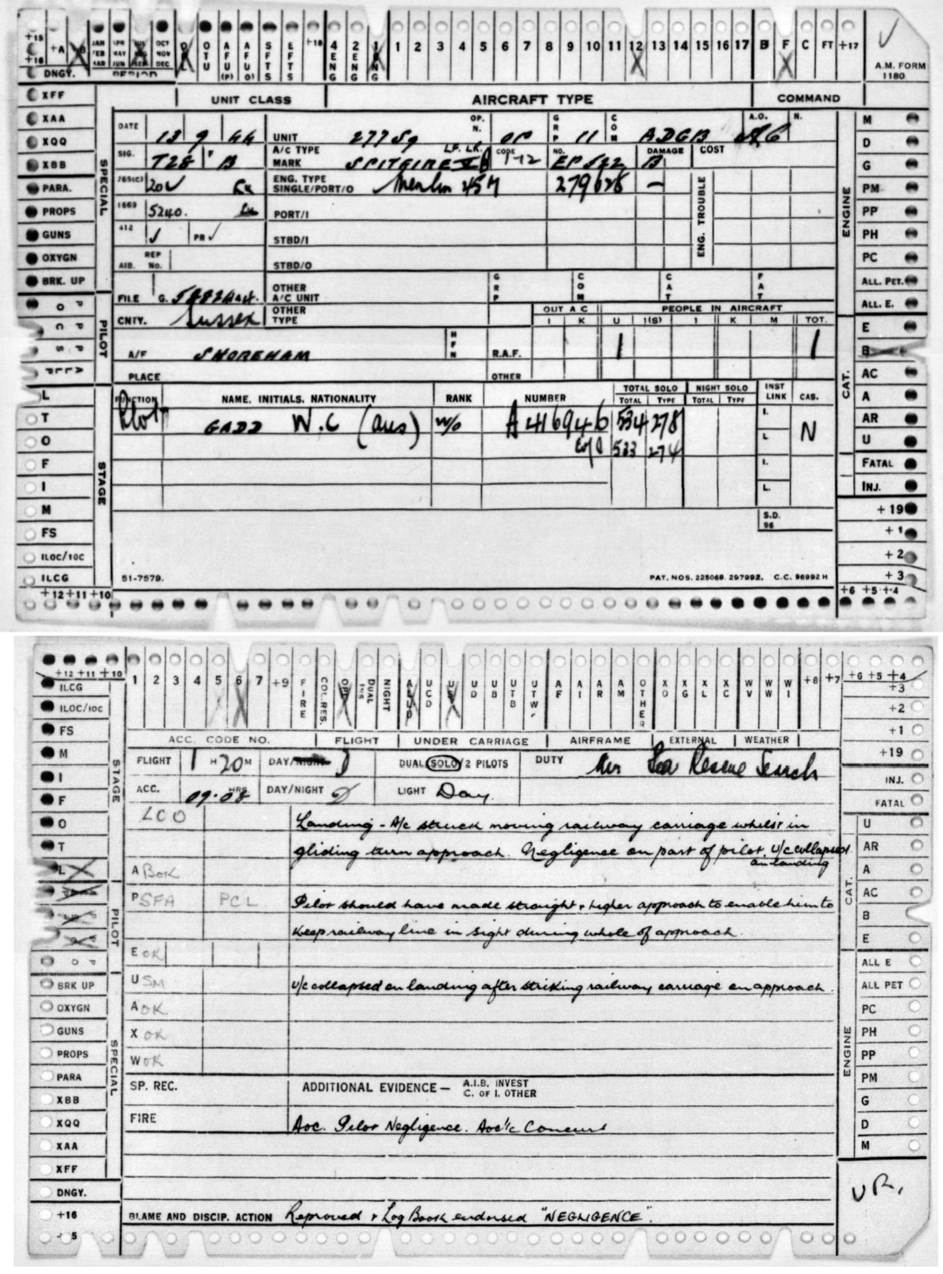
RAF Accident Report A.M. Form 1108 for
Spitfire no.EP522 (227
Squadron) recorded the time as 9:08am.
Southern Railway Report
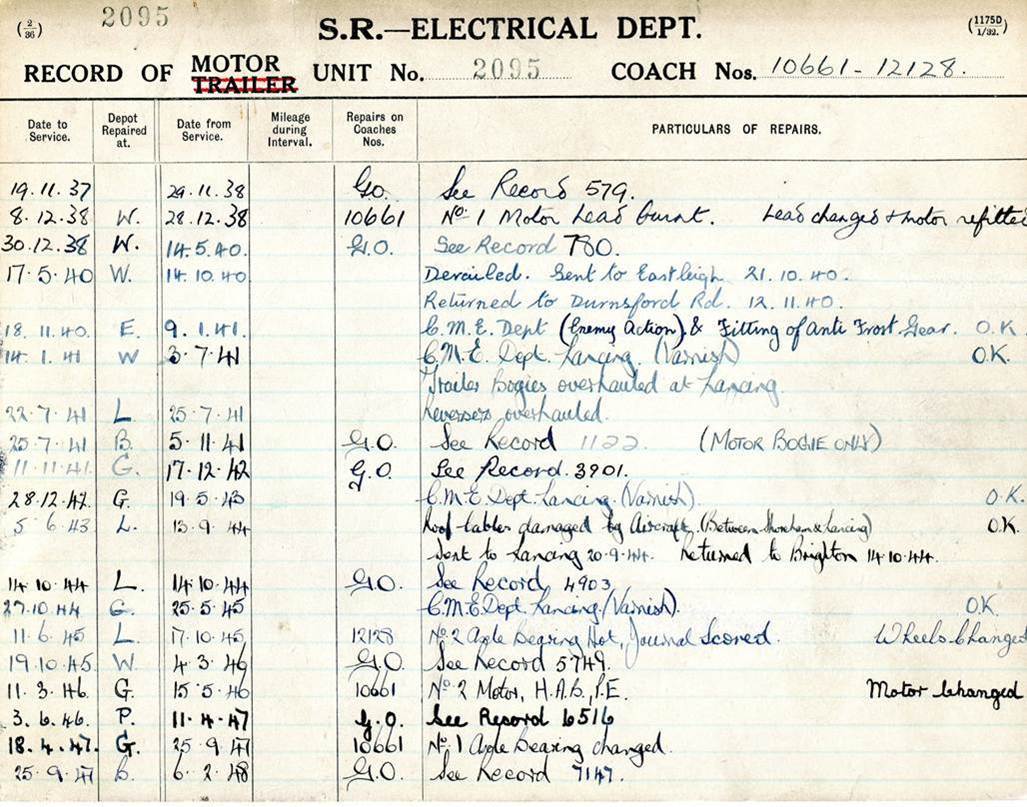
Southern Railway
Record Card for unit no.2095
The Southern Railway Record
Card identifies the unit was repaired at Lancing states: “Roof cables
damaged by aircraft (Between Lancing & Shoreham). Sent to Lancing 20.9.44.
Returned to Brighton 14.10.44”
RAF Reports

|
No. 277
Squadron RAF (Air–Sea Rescue): Operations Record Book (Form 540 –
Summary of Events), © National
Archives of the UK (TNA), AIR 27/1602/17 |
This report excerpt from the
National Archives of the UK (TNA), AIR 27/1602/17 – No. 277
Squadron RAF (Air–Sea Rescue): Operations Record Book (Form 540 –
Summary of Events), p. 6, entry for 13 September 1944 states.
“Wing Commander A.D. Grace, DFC, present until
approximately 14.00 hours. Weather fine all day. No wind. Accident to Spitfire
P522 – Warrant Officer W. Gadd. In connection with this accident,
Adjutant phoned S.R. Worthing to ask if any report had been handed in. The
workshop foreman, whilst stating that official report would be rendered from
their control office at Redhill, said he could inform us unofficially that
there was damage to the coach over the motorman's cabin, roof dented, periscope
damaged, brake of that part of compartment out-of-action and roof damage in one
compartment. No personal injury."
|
Air Ministry,
Aircraft Accident Record Card (Form 1180) for Spitfire Vb
EP522, 277 Squadron RAF, 13 September 1944. Pilot W/O W.
C. Gadd (RAAF). RAF Museum
Archives, Hendon. (Crown copyright expired). |
The Air Ministry, Aircraft
Accident Record Card (Form 1180) for Spitfire Vb
EP522) gave further brief details:
“Landing
– aircraft struck moving railway carriage whilst in gliding turn
approach. Negligence on part of pilot. Pilot should have made straight and
higher approach to enable him to keep railway line in sight during whole of
approach. Undercarriage collapsed on landing after striking railway carriage on
approach”.
The pilot was reproved and his logbook was endorsed
NEGLIGENCE. The Birmingham-built Spitfire (model VB) was too badly damaged to
be dealt with by the RAF ground crew at Shoreham and need to be repaired off
site.
Worthing Herald
On Friday 15th September 1944
the Worthing Herald published the following new report under the headline
‘Plane Strikes Train’.
“A
Southern Railway electric train and its passengers had a fortunate escape on
Wednesday. A ‘plane, which it is understood was in difficulties, was
flying low over the railway line between Lancing and Shoreham. The ‘plane
struck the motorman’s cab which was damaged, but no one was hurt. The
train after inspection proceeded on its journey. The pilot of the ‘plane
succeeded in making a landing”.
Warrant Officer W. Gadd
Born Crystal Brook, (South Australia) in 1923,
William Clark Gadd enlisted into the RAAF on the 8th November 1941,
training in Australia. On the 27th November 1942, Gadd took up an attachment to the RAF
arriving in the UK on the 26th February 1943. Having completed pilot
training on the 10th January 1944 Flying Officer Gadd was posted to No.277
Squadron RAF an Air Sea Rescue squadron which was based at RAF Shoreham in,
Sussex. A year later Warrant
Officer Gadd was posted to No.453 Squadron RAAF at RAF Matlaske,
Norfolk on 6th January 1945. He survived the war and BloodandCustard
thanks him for his service.
RAF Shoreham
Shoreham had been used by the Royal Flying Corps
during WW1 and in 225 Squadron arrived in July 1940 joined by 422 Fligh in October 1940.
A year later both units had been relocated.
No 11 Group Target Towing Flight arrived in October
1941 with search and rescue duties also being undertaken Air Sea Rescue Flight
RAF which became 227 Squadron receiving Supermarine Spitfires in February 1943.
The squadron moved away from Shoreham in October 1944 and was disbanded on 15th
February 1945.
Shoreham Airfield
With first recorded flight taking place in 1910, Shoreham
Airfield is located immediately to the north of the railway line with the
former Bungalow Town /Shoreham Airport station being 6 miles 77chains from the
buffer stops at Brighton. Bungalow Town Halt opened in 1910 and closed around
the commencement of electrified rail services on 1st January 1933
before being reopened as Shoreham Airport on 1st July 1935 before
closing on 15th July 1940.
Today the railway line is equipped with a
post-mounted tripwire (similar to Gatwick Airport) which if activated by a
low-flying aircraft, trips the power to the conductor rail and places the
approaching signals at danger.
At its closest Shoreham Airfield’s control
tower is around some 113 meters from the railway line. From the control tower
to the likely intersection of the wartime runway approach and the railway line
is 725 meters (from the control tower).
Information and research with thanks
to Warrant Officer W. Gadd’s relative.